Resources Library: Publications/Reports
Start a Search:
Legal Advocacy Manual 2013
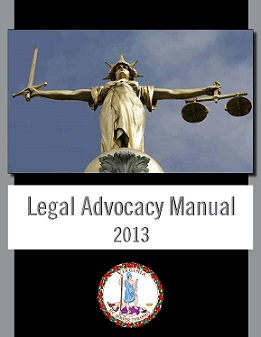
The Legal Advocacy Manual provides victim advocates (as well as victims) with a comprehensive guide to help domestic and sexual violence victims in Virginia through some of the legal processes in which they may become involved. It provides both basic and intermediate levels of information about legal advocacy--what it is, the difference between civil and criminal justice systems, definitions of commonly used legal terms, and how to avoid the unauthorized practice of law, among other topics. The manual offers context for the emotional, logistical, and legal hurdles involved in protective orders, criminal prosecutions, visa applications, and divorces. It is 76 pages long and is in PDF form. Susheela Varky of Virginia Poverty Law Center updated it in June 2013 for recent changes in the law. Ms. Varky has used the manual as a resource for in-person trainings geared to victim advocates, and is available to tailor such trainings for your local Virginia domestic or sexual violence program.
Lessons Learned from the Underserved Populations Learning Collaborative Project
The Underserved Populations Learning Collaborative(UPLC) was a project that approximately 40 of Virginia's member sexual and domestic violence agencies, Department of Criminal Justice Services (victim services), Virginia Department of Social Services (office of family violence), and the Action Alliance partnered, collaborated, co-learned together for over about 5 years from start to finish. This report is glimpse into some of the lessons we learned along the way, as well as the resources, presentations, and evaluations that were cultivated for this project.
Click here to download the report.
Level of Burden: Women with More Than One Co-Occurring Disorder
This journal article was provided at the workshop titled "Beyond Trauma: A Presentation of Dr. Stephanie Covington’s Trauma Theory and Beyond Trauma Women’s Groups" at the Virginia Department of Social Services Office of Family Violence Promising Practices conference on September 16, 2013.
Levels of Violence in the United States
This document was provided at the workshop titled "Beyond Trauma: A Presentation of Dr. Stephanie Covington’s Trauma Theory and Beyond Trauma Women’s Groups" at the Virginia Department of Social Services Office of Family Violence Promising Practices conference on September 16, 2013.
Mapping Community Ecosystems of Collective Care
By Shannon Perez-Darby and Andrea J. Ritchie
Since the 2020 Uprisings, there has been an explosion of interest, activity, and organizing around community-based approaches to building safer communities free from the violence of policing. Throughout this period, Interrupting Criminalization has been supporting these efforts by sharing expertise built over decades of organizing for and practicing transformative justice-based approaches to building liberatory communities with resources, toolkits, webinars, podcasts, skill-shares, trainings, cohorts, and learning and practice spaces.
In many of these spaces, and within broader campaigns and movements to divest from policing and invest in the building blocks for safer communities, critical questions and conundrums began to surface from organizers. At the core of these concerns are the questions of:
- How do we build shared definitions, values, and practices of safety across neighborhoods and organizations working within a city?
- How do we weave our small, often relatively new community safety projects — ranging from mutual aid formations, to transformative justice practitioners, to neighborhood defense organizations, to community fridges, to violence interruption and crisis response teams operating at hyper-local levels — into robust, palpable neighborhood and city-wide ecosystems of care that people can feel, trust, and rely on more fully to collectively build greater safety and wellbeing?
- How do we relate to state institutions and resources as we are doing so?
This toolkit offers some resources, responses, and additional questions to consider based on our work and practice spaces.
In particular, this toolkit emerges from the work of our Creating Community Ecosystems of Collective Care Cohort, which launched in March of 2022 and featured over a dozen organizations working in community safety coalitions in Miami, Durham, NC, Seattle, Milwaukee, Phoenix, Minneapolis, and Atlanta. This cohort consisted of groups who were already engaged in this work; it was designed as a virtual space for organizers to learn, practice, and strategize together toward building more robust community ecosystems of care at the neighborhood and city-wide levels.
In addition to breaking isolation, cross-pollinating across communities, and creating a virtual community of practice, the goal was to collectively create resources to support communities beyond the cohort who are grappling with similar questions. This toolkit is that vision come to life.
As communities face increased policing, criminalization, and organized abandonment; mounting state violence, repression, and authoritarianism; escalating white supremacist, homophobic, and transphobic violence; and climate collapse; building skilled, coordinated, expansive, and robust ecosystems of collective care is only becoming more and more essential to collective survival.