Resources Library: Multidisciplinary
Start a Search:
Honeycomb Reflection and Share Out
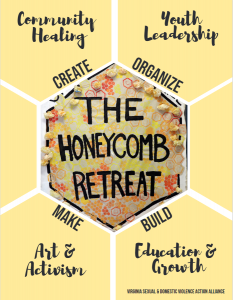
In July 2019 the Action Alliance organized and hosted a week-long retreat for young advocates, activists, and artists ages 17-23 called the Honeycomb Retreat. Our participants (fellows) went to workshops on systemic and interpersonal violence, consensual communities, zines for visionary futures, and using herbalism practices to heal from trauma. They also went to art sessions during which they worked with local artists-in-residence to create art in response to the things they were learning in their workshop and their own personal experiences. The week ended with a visioning session where fellows had the opportunity to talk about their skills they bring to our movement, the barriers that impact their full participation, the resources and support they need from adult allies, and what they are excited to do next!
This is an informational and reflective zine that describes some of our goals, frameworks, and outcomes—as well as a general overview of what happened at the retreat and who was there. Please do not hesitate to reach out and connect on these topics!
Human Trafficking Prevention Toolkit
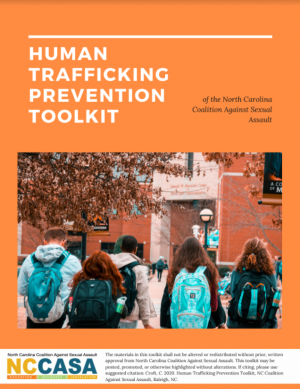
Human trafficking prevention has at times been framed primarily as a criminal justice priority or been siloed from other forms of violence prevention. As experts in sexual violence prevention, NCCASA recognizes sex trafficking as a form of sexual violence and the connection of sexual violence to all forms of human trafficking. NCCASA is pleased to present the Human Trafficking Prevention Toolkit. In this toolkit, you'll find the Human Trafficking Prevention Overview, an overview of what human trafficking is and the public health approach to violence prevention, an exploration of the historical context that informs current frameworks and gaps, tips for effective upstream prevention, and strategies for incorporating a harm reduction lens into your human trafficking prevention work, as well as critical considerations in selecting a prevention strategy.
I Ask - Sexual Assault Awareness Month
Sexual Assault Awareness Month (observed annually in April) is a campaign to raise public awareness about sexual violence and educate communities on how to prevent it. The campaign theme, I Ask, champions the message that asking for consent is a healthy, normal, and necessary part of everyday interactions. You can download and print materials for your Sexual Assault Awareness Month activities below!
- I Ask for Consent Palm Card and Handout cover the basics of knowing how to ask for and recognize consent. For best graphic quality, download the PDF and then print it out.
- I Ask for Digital Consent Palm Card and Handout discuss the importance of consent in online interactions. For best graphic quality, download the PDF and then print it out.
- I Ask How to Teach Consent Early Palm Card and Handout instructs parents on how to model consent with children in late childhood and early adolescence. For best graphic quality, download the PDF and then print it out.
- I Ask How Power Impacts Consent Palm Cards and Handout looks at the way imbalances of power impact consent. For best graphic quality, download the PDF and then print it out.
For additional resources, visit the National Sexual Violence Resource Center (NSVRC).
I-CAN! Understanding Protective Orders in Richmond, Virginia
The I-CAN! Understanding Protective Orders in Richmond, Virginia Booklet describes what a protective order is, the types of protective orders, the process of obtaining a protective order in Richmond, Virginia, tips about going to court, what to do after you receive a protective order, and various resources.
Attached is (1) the English version of the booklet, (2) a large print English version of the booklet, and (3) a Spanish version of the booklet.
Immigrant Families & Public Benefits: Under a New Presidential Administration
Recent changes to immigration enforcement have resulted in social services agencies across Virginia reporting decreased numbers of immigrant families requesting access to services. Some immigrant families even seek to withdraw their U.S.-born children from crucial benefits for which they are eligible due to fear of immigration enforcement. This PDF document is from a webinar given on March 31, 2017, to discuss changes in the immigration enforcement landscape, its impact on immigrant communities, immigrants' eligibility for public benefits for themselves and their U.S.-born children and strategies to encourage immigrant families to continue to access public benefits for which they are eligible. The webinar was sponsored by the Virginia League of Social Services Executives, Legal Aid Justice Center, Virginia Poverty Law Center and the Virginia State Bar Access to Justice Committee.