Resources Library: Advocates
Start a Search:
Sustaining the Movement: A 10-Year Plan for Virginia’s Sexual and Domestic Violence Programs
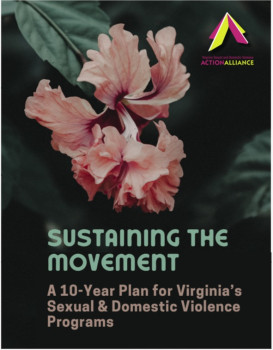
In August 2021, during the second summer of the COVID-19 pandemic, a diverse group of Sexual and Domestic Violence Agency (SDVA) Directors convened to begin discussing the significant and ongoing funding and sustainability challenges faced by Virginia’s 70+ crisis response agencies. The Sustainability Planning Alliance (SPA) was formed, consisting of six Executive Directors and Action Alliance leadership. They met 1-2times a month for the next 18 months. The group represented diverse regions and perspectives across Virginia – including Hampton, Arlington, Fairfax, White Stone, Charlottesville, Harrisonburg, Richmond, and Radford – with public and non-profit organizations represented, dual sexual and domestic violence and single-issue agencies, Black, Brown and White agency leaders, urban, rural, and suburban service areas, and collectively, more than 100 years of direct experience in Virginia’s movement to end sexual and domestic violence. Based on these ongoing discussions and rigorous data gathering, the SPA offers the following 10-Year Movement Sustainability Plan and recommendations to the field.
RECOMENDATIONS FOR THE FIELD
- For Sexual and Domestic Violence Agencies (SDVAs) and Advocates
- - Build a strong diversified financial foundation for the work.
-
- Create robust administrative and operational capacity that supports growth, sustains current programs and staff, and is nimble in the face of programmatic and administrative challenges.
- For Funders and State Partners
- - Build active, reciprocal, and power-sharing partnerships with SDVAs.
-
- Engage with SDVAs to build a strong infrastructure for the field that can access and manage diverse resources and support well-resourced staff.
- For Legislatorsand Policy Leaders
- - Increase state and federal investments in community safety and sexual and domestic violence prevention.
-
- Advocate for the sustainability and growth of Virginia’s local SDVAs.
- For the Virginia State Coalition (Action Alliance)
- - Provide ongoing and robust training, technical assistance, and support to SDVAs to advance local sustainability strategies.
- - Create a unified mission, vision and values for the work of the SV/DV field while supporting agency autonomy, highlighting SDVAs and their value and impact, and providing forums and venues for people in the field to gather and share with people in similar roles and across identities.
This plan is not a mandate, rather it is a set of strategies, grounded in shared values and collective expertise gathered from advocates and directors across Virginia’s movement to end sexual and domestic violence. It is intended to act as a blueprint towards movement sustainability. Our vision is that these recommendations will become a reality and that at the local, state, and federal level, we will move in alignment towards a future in which every sexual and domestic violence agency throughout the Commonwealth is thriving and able to effectively meet the full needs of survivors, families, and their communities.
Download the plan using the link below.
Tactics of Oppression

Power and control look alike whether perpetrated against an intimate partner or an entire cultural/ethnic group.
Whether we are talking about power and control within an intimate relationship, or within the whole of U.S. society, we see the same tactics used to maintain an unequal distribution of power, control and access to resources.
This handout outlines examples of oppressive tactics used to control individuals in the context of intimate relationships compared with similar tactics used by government entities to control entire ethnic or cultural groups and communities.
Attribution: Content developed by Nathaniel Shara for 2012 Northwest Network Q&A for Advocates Training, Seattle WA - nathan@nwnetwork,org. Used with permission.
Tech Abuse: Information from the Field Survey Findings from the Conference on Crimes Against Women
NNEDV surveyed over 300 conference attendees on what types of technology misuse survivors are reporting, the number of cases their agency sees of technology misuse, and their agency’s ability to respond to survivor’s technology concerns. This report shows their findings.
Tech Talk: Demystifying AI and the Risks it Poses to Survivors of Domestic Violence
The Safety Net team at the National Network to End Domestic Violence (NNEDV) is excited to announce their latest Tech Talk!
In recent years, there have been many advances in artificial intelligence (AI). Highly-capable AI-powered technologies are now easier to access and use by the general audience. In the context of domestic violence, this means a perpetrator has more tools to impersonate and cause harm to a survivor. In this Tech Talk, presenters will clarify some misconceptions surrounding AI and domestic violence, explain the risks AI poses to survivors of domestic violence, and what they can do to mitigate these risks.
This talk is available in English and Spanish.
Click here to access the recordings.
Technology and Abuse in Later Life

Technology is an invaluable resource for older survivors. Individuals may use the Internet, for example, to find support and cope with issues of abuse in later life. Yet, abusers can misuse technology as a tactic of abuse, which can be dangerous and potentially lethal.
In December 2014, with help from Disability Rights Wisconsin, End Domestic Abuse Wisconsin and the Safety Net Project of the National Network to End Domestic Violence, NCALL released this toolkit for older adults with two goals in mind: to provide information about common technologies, including assistive technology, and to identify ways older adults can safeguard themselves from those who misuse technology to control, harass, stalk, and/or threaten them. The toolkit contains the following:
1. Tech 101: Frequently Used Terminology – a glossary of tech terms, many of which are referenced in the toolkit.
2. Tech Tips for Older Adults: Tech Safety – a general overview of computer, cell phone and Internet safety.
3. Tech Tips for Older Adults: Online Privacy & Safety – An overview of the importance of online privacy and strategies for maintaining privacy and safety online.
4. Technology and Abuse in Later Life – An overview of the ways abusers misuse technology within the context of abuse in later life.
5. Assistive Technology – An overview of assistive technology, including what it is, who uses it and resources for finding out more about assistive technology.
6. Examples of Assistive Technology – An overview of assistive technologies for individuals who are Deaf or hard-of-hearing, have speech disabilities, are blind or have low vision, or have physical, motor or communication disabilities.
7. Assistive Technology and Abuse in Later Life – A general overview of the ways abusers may misuse assistive technologies to cause harm.
8. Tech Resources – A list of selected resources related to technology and technology safety.