Resources Library: Law Enforcement
Start a Search:
Law Enforcement Domestic Violence Investigative Checklist: Responding Officer/Deputy Responsibilities
This checklist is intended to be used as a tool/resource for law enforcement. It describes an initial response to a domestic violence call and does not represent a complete approach to these cases. This checklist does not supersede any existing general orders, policies, or procedures, and is designed to be used in conjunction with the Virginia Department of Criminal Justice Services (DCJS) model domestic violence policy. The model policy is available on the DCJS website at www.dcjs.virginia.gov.
Levels of Violence in the United States
This document was provided at the workshop titled "Beyond Trauma: A Presentation of Dr. Stephanie Covington’s Trauma Theory and Beyond Trauma Women’s Groups" at the Virginia Department of Social Services Office of Family Violence Promising Practices conference on September 16, 2013.
Liberatory Practices for Accountability Across the Social Ecological Model
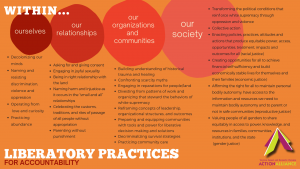
What does accountability look like without punishment, isolation, and shaming?
What are the shifts we can make in ourselves, our relationships, communities, and as a society to move from punishment to true accountability, which builds connection and encourages growth?
This infographic, created for the Action Alliance webinar series, “Reimagining Our Legacy: Transforming from Criminalization to Liberation”, seeks to offer a few ways in which we can practice methods of accountability that liberate us from punishment and harm and move us toward healing and connection.
Officers and Advocates: Oil and Water?

From End Violence Against Women International
One of our most popular articles addresses the collaboration between law enforcement and victim advocates, with the title Oil and Water? This article was first written years ago, but it remains just as timely today. We are therefore providing the information in a series of Training Bulletins.
In this first installment, we begin with a historical perspective and explore the role of victim advocates within the context of the criminal justice system. In the second bulletin, we describe why some professionals are reluctant to integrate victim advocacy in their work and identify strategies for overcoming that reluctance. Then in the final installment, we walk through an example of how advocates might address one particular challenge: When the law enforcement investigator feels like the facts "don't add up."
CLICK HERE FOR PART 1 OF THE SERIES.
Pet Abuse and the Link to Domestic Violence

Sheltering Animals for Abused Families (http://www.richmondspca.org/saaf)
SAAF (Sheltering Animals for Abused Families) Program is a partnership between the Richmond SPCA and the YWCA, with the purpose of providing a safe, temporary shelter to care for the pets of abused women and children.
Safe Havens Mapping Project – Virginia
The entities included in this listing either provide sheltering services for the companion animals of domestic violence victims, have a relationship with an entity that does, or provide referrals to such facilities.
https://awionline.org/safe-havens?distance[postal_code]=&distance[search_distance]=25&distance[search_units]=mile&state=Virginia
Virginia Consolidated Cruelty Statutes
https://www.animallaw.info/statute/va-cruelty-consolidated-cruelty-statutes
Domestic Violence and Animal Cruelty - ASPCA Resources Including What Law Enforcement Can Do About It
https://www.aspca.org/fight-cruelty/report-animal-cruelty/domestic-violence-and-animal-cruelty
National Link Coalition – Working Together to Stop Violence Against People and Animals
Rich source of information and guidance.
http://nationallinkcoalition.org/
RedRover Domestic Violence Safe Escape Grants
RedRover offers financial assistance for victims of domestic violence and their pets through our Safe Escape grant program. The goal of the program is to help families with pets safely escape domestic violence together. Grants may be provided for temporary boarding and veterinary care.
http://www.redrover.org/domestic-violence-safe-escape-grants
American Humane Association: Facts About Animal Abuse & Domestic Violence
http://www.americanhumane.org/interaction/support-the-bond/fact-sheets/animal-abuse-domestic-violence.html