Resources Library: Law Enforcement
Start a Search:
SAFE RETURN: Working Toward Preventing Domestic Violence When Men Return from Prison

The Safe Return Initiative focuses on strengthening domestic violence services for African American women and their children when they are facing the return of an intimate partner from prison. It does this by building culturally specific technical capacity within and cooperation among justice institutions and community-based and faith-based organizations. Its goals are to keep women and their children safe and improve the odds of successful reentry by offering peer-based learning, training, information sharing, and on-site assistance designed to help criminal justice and community-based
organizations better serve African Americans dealing with prisoner reentry.
Sample Supplemental Domestic Violence and Strangulation Report Forms for Law Enforcement
These documents are samples of supplemental report forms that law enforcement agencies can use when documenting domestic violence and/or strangulation incidents. These forms are samples and intended to provide a framework that and local law enforcement agencies and community teams can adapt for their own use.
Sexual Assault Response Teams (SART): A Model Protocol for Virginia
In 2004, the Virginia General Assembly passed legislation stating that “the Department of Criminal Justice Services shall promote the use of local and regional sexual assault response team policy and protocol, established pursuant to subdivision 46 of §9.1-102 of the Code of Virginia, as an integral part of an effective coordinated community response to sexual assault” (Virginia Acts of Assembly, Chapter 980). The Code directs that DCJS shall “establish training standards and publish a model policy and protocols for local and regional sexual assault response teams” (§9.1-102). In accordance with these legislative mandates, DCJS developed these guidelines based on review of existing state and national protocols and best practices and consultations with local Virginia sexual assault response team members. This model protocol focuses on adult sexual assault.
Sexual Violence in Later Life

This four page document outlines specific information on the broad range of offenses perpetrated against people age 60 and beyond, and discusses how advocates can respond to the special needs of older sexual violence victims.
Summary: Virginia’s Plan for Primary Prevention of Intimate Partner Violence
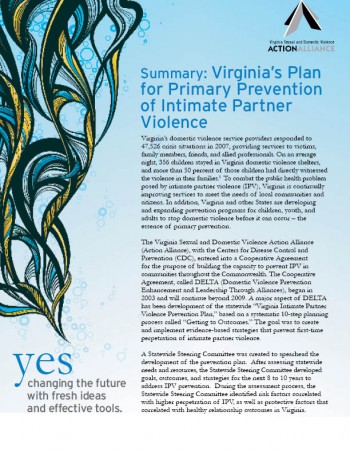
The Virginia Sexual and Domestic Violence Action Alliance (Action Alliance), with the Centers for Disease Control and Prevention (CDC), entered into a Cooperative Agreement for the purpose of building capacity to prevent IPV in communities throughout the Commonwealth. The Cooperative Agreement, called DELTA (Domestic Violence Prevention Enhancement and Leadership Through Alliances), began in 2003 and continues today.
A major aspect of DELTA has been development of the statewide “Virginia Intimate Partner Violence Prevention Plan,” based on a systematic 10-step planning process called “Getting to Outcomes.” The goal was to create and implement evidence-based strategies that prevent first-time perpetration of intimate partner violence. This document summarizes the 5 goals developed during the planning process.
Published by Virginia Sexual & Domestic Violence Action Alliance. 2009.
4 pages.